

Blog
Role of Knee Support in Running: Injury Prevention and Performance


Finding the right knee support can feel like a real challenge for runners in Paris who juggle regular training and marathon ambitions. With the knee bearing so much stress during every stride, injury risks and setbacks are never far from mind. Professional-grade knee supports offer specialized protection by stabilizing the joint, preventing excessive movement, and reducing mechanical strain. This guide reveals how proper knee bracing can keep you running stronger, safer, and longer—no matter your pace or goals.
Table of Contents
- Defining Knee Support and Its Purpose
- Types of Knee Support for Runners
- How Knee Braces Function in Running
- When and Why Runners Need Support
- Risks, Misconceptions, and Usage Mistakes
Key Takeaways
| Point | Details |
|---|---|
| Knee support stabilizes the joint | Essential in preventing injuries and managing pain during physical activities. |
| Different types of knee braces serve specific purposes | Prophylactic, functional, patellofemoral, and rehabilitative braces cater to varying athlete needs. |
| Proper fit and professional guidance are crucial | Runners should consult experts to select appropriate support that matches their biomechanics and performance goals. |
| Knee braces are not a universal solution | Runners must also address underlying issues through rehabilitation and strength training to optimize performance. |
Defining Knee Support and Its Purpose
Knee support represents a critical protective mechanism designed to stabilize and safeguard the complex knee joint during athletic performance and daily activities. As one of the most intricate and load-bearing joints in the human body, the knee requires specialized protection against potential injuries and excessive stress.
At its core, knee support is fundamentally about maintaining joint alignment and reducing potential mechanical strain. Healthcare providers recommend knee braces to protect the knee by keeping it in proper positioning, preventing unexpected movements, and redistributing mechanical pressures during high-impact activities like running.
Knee supports serve multiple essential functions for athletes and active individuals:
- Stabilization of the knee joint during dynamic movements
- Injury prevention by controlling excessive joint rotation
- Pain reduction through targeted compression and support
- Performance enhancement by improving biomechanical efficiency
- Rehabilitation assistance following previous injuries
The primary mechanisms of knee support involve mechanical intervention and physiological response. Bracing techniques minimize injury risks by providing external stability during anteroposterior and rotational forces, protecting against lateral stress, and improving patellar tracking.
Pro tip: Choose knee supports that match your specific activity level and existing physical condition to maximize protection and performance potential.
Types of Knee Support for Runners
Runners encounter diverse knee support needs that demand specialized bracing solutions tailored to specific biomechanical challenges and injury prevention strategies. Healthcare professionals classify knee braces into several critical categories designed to address unique athletic requirements and physiological conditions.
The primary types of knee support for runners include:
- Prophylactic Braces: Preventative supports designed to minimize injury risks during high-impact running activities
- Functional Braces: Specialized supports for runners with existing ligament damage or joint instability
- Patellofemoral Braces: Targeted supports that improve kneecap alignment and reduce anterior knee pain
- Rehabilitative Braces: Controlled motion supports used during injury recovery and gradual return to running
Runners require specific knee brace configurations based on individual biomechanical needs, injury history, and performance goals. Different bracing techniques provide distinct levels of joint stabilization, compression, and mechanical support.
Each knee support type offers unique benefits for runners, ranging from preventing potential injuries to managing existing joint conditions. The selection process involves carefully evaluating individual running mechanics, previous injury patterns, and specific performance objectives.
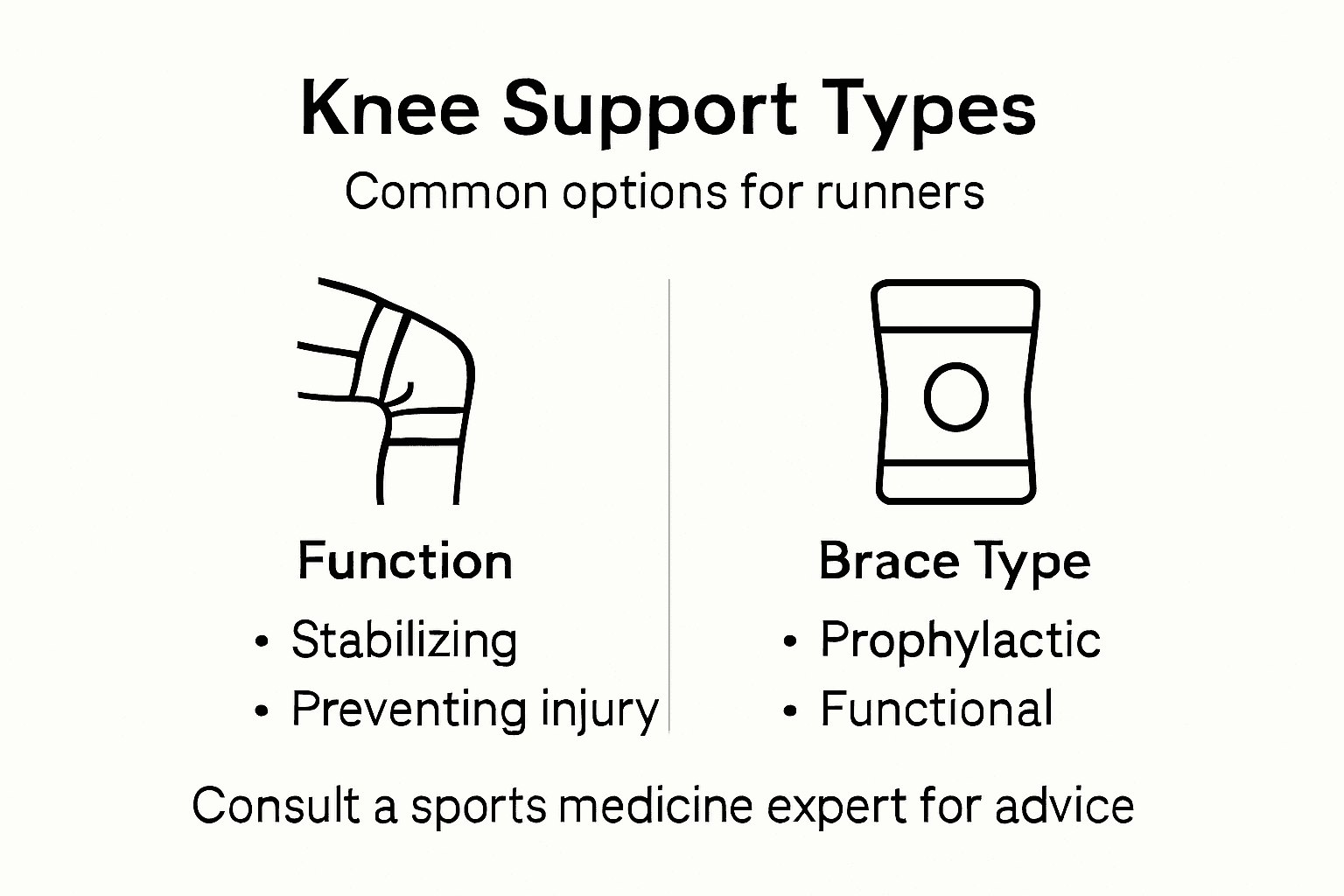
The following table compares the main types of knee support for runners by their ideal use and support level:
| Knee Brace Type | Common Use Case | Support Level |
|---|---|---|
| Prophylactic | Injury prevention during sports | Moderate support |
| Functional | Post-injury, ligament instability | High support |
| Patellofemoral | Tracking and kneecap issues | Targeted support |
| Rehabilitative | Controlled movement during recovery | Restrictive support |
Pro tip: Consult a sports medicine professional to determine the most appropriate knee support configuration for your specific running style and physiological requirements.
How Knee Braces Function in Running
Knee braces serve as sophisticated biomechanical interfaces that provide critical joint protection during high-intensity running activities. Bilateral hinged knee braces absorb mechanical forces that typically stress the knee during dynamic movements like jumping, pivoting, and sudden directional changes.
The primary functional mechanisms of knee braces include:
- Mechanical Load Redistribution: Spreading forces across a larger surface area
- Joint Stabilization: Limiting excessive or abnormal knee motion
- Proprioceptive Feedback: Enhancing neuromuscular awareness during movement
- Compression Support: Providing targeted muscular and ligament compression
Knee braces control rotational and anteroposterior forces by implementing strategic design elements such as hinged mechanisms, adjustable straps, and anatomically contoured structures. These features work collaboratively to minimize injury risk and optimize biomechanical efficiency.

The effectiveness of knee braces depends on precise engineering that accounts for individual runner’s biomechanics, movement patterns, and specific physiological requirements. Advanced bracing technologies incorporate materials and design principles that adapt to the dynamic stress encountered during running.
Pro tip: Ensure your knee brace fits correctly by checking for proper tension, range of motion, and comfort during trial runs.
When and Why Runners Need Support
Running places extraordinary biomechanical demands on the knee joint, creating complex stress patterns that can potentially lead to injury and performance limitations. Runners may require knee support when experiencing specific physiological challenges that compromise joint stability and movement efficiency.
Critical scenarios demanding knee support include:
- Pain Management: Addressing conditions like iliotibial band syndrome
- Injury Recovery: Providing structured rehabilitation after knee injuries
- Biomechanical Correction: Improving alignment and reducing joint stress
- Performance Optimization: Enhancing neuromuscular control during running
- Preventative Protection: Mitigating potential future injury risks
Runners should consider knee support when experiencing symptoms such as persistent knee pain, reduced range of motion, muscle weakness, or observable biomechanical irregularities during running. These support mechanisms help redistribute mechanical loads, stabilize joint movements, and provide crucial proprioceptive feedback that can prevent potential injuries.
The decision to use knee support is not a sign of weakness but a strategic approach to maintaining long-term running health and performance. Professional athletes and recreational runners alike recognize that proactive joint protection can significantly extend their running careers and minimize potential chronic conditions.
Here is a summary of factors influencing when runners may need extra knee support:
| Factor | What It Means for Runners | Professional Guidance |
|---|---|---|
| Pain symptoms | May indicate overload or injury risk | See sports medicine provider |
| Reduced motion | Limits stride efficiency | Consider rehab plan |
| Muscle weakness | Compromises joint stability | Strength training suggested |
| Biomechanical issues | Alters running gait | Biomechanical assessment advised |
Pro tip: Schedule a biomechanical assessment with a sports physiotherapist to determine your specific knee support requirements and potential injury prevention strategies.
Risks, Misconceptions, and Usage Mistakes
Knee support technologies are powerful tools for runners, but they are not universal solutions that automatically resolve all knee-related challenges. Misconceptions about knee braces can lead runners to develop unrealistic expectations or potentially harmful usage patterns that compromise their athletic performance and joint health.
Common risks and misconceptions in knee support include:
- Cure-All Fallacy: Believing braces definitively solve underlying knee problems
- Overreliance: Using knee supports as a permanent crutch instead of addressing root causes
- Incorrect Sizing: Wearing braces that do not match individual biomechanical requirements
- Self-Diagnosis: Selecting knee supports without professional medical guidance
- Muscle Dependency: Potentially weakening supporting muscle groups through excessive brace usage
Runners must understand that knee braces are supplementary tools designed to provide temporary support, pain relief, and biomechanical assistance. They cannot replace comprehensive rehabilitation, strength training, or professional medical assessment. Effective knee support requires a holistic approach that combines proper equipment, targeted exercises, and professional guidance.
The most critical mistake runners make is viewing knee supports as passive solutions rather than active components of a broader injury prevention and performance optimization strategy. Professional athletes recognize that knee braces are precision instruments requiring careful selection, proper fitting, and strategic implementation.
Pro tip: Consult a sports medicine professional to develop a personalized knee support strategy that addresses your specific biomechanical needs and running objectives.
Enhance Your Running Performance and Protect Your Knees with KneeSolution
Running creates unique demands on the knee joint that call for specialized support to prevent injury and boost performance. Whether you need stabilization for existing knee issues, targeted compression to reduce pain, or rehabilitation after injury, KneeSolution offers professional-grade solutions tailored to your needs. Our range of knee pads and braces provides biomechanical support that matches the functional demands described in the article such as lateral stabilization, patellofemoral realignment, and proprioceptive feedback.
Take control of your knee health today with our expertly designed products trusted by athletes and active individuals alike. Discover effective options like orthopedic braces, compression sleeves, and recovery devices that accelerate healing and improve comfort. Visit KneeSolution now to find the perfect knee support. Act now to reduce your injury risk, enhance your running efficiency, and sustain long-term joint health.
Frequently Asked Questions
What are the main functions of knee support for runners?
Knee support helps with stabilization of the knee joint, injury prevention, pain reduction, performance enhancement, and rehabilitation after injuries.
How do I choose the right type of knee brace for my running needs?
Consider your specific activity level, any existing injuries, and your performance goals. Consulting a sports medicine professional can help determine the best fit for your needs.
When should I consider using a knee brace while running?
You should consider using a knee brace if you experience persistent knee pain, reduced range of motion, muscle weakness, or any biomechanical irregularities during your runs.
Can knee braces replace strength training and rehabilitation?
No, knee braces are not a substitute for strength training or rehabilitation; they provide temporary support and should be part of a broader injury prevention strategy that includes proper exercises and medical guidance.
